NightPosture began with a simple mismatch: a person can fall asleep on their side, but that does not reveal where they spent the rest of the night.
What the report showed
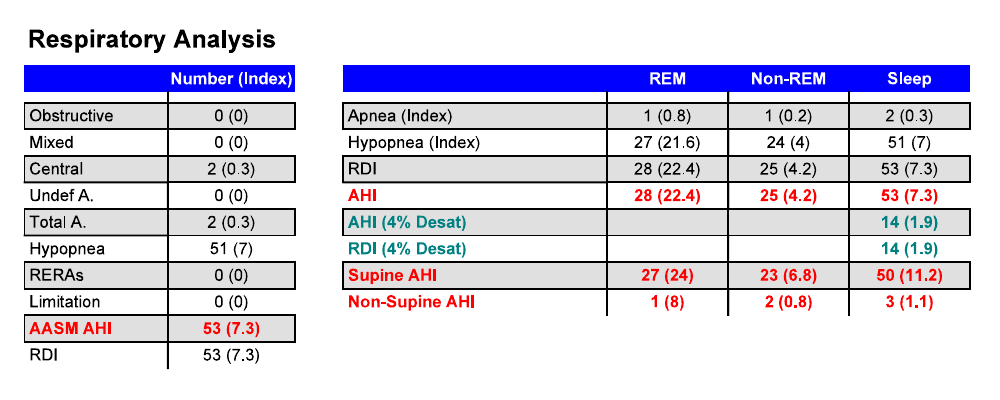
In this one overnight study, the report listed an overall apnea-hypopnea index (AHI) of 7.3 events per hour. The position-specific rows were markedly different:
- Supine AHI
- 11.2 events per hour while on the back
- Non-supine AHI
- 1.1 events per hour while off the back
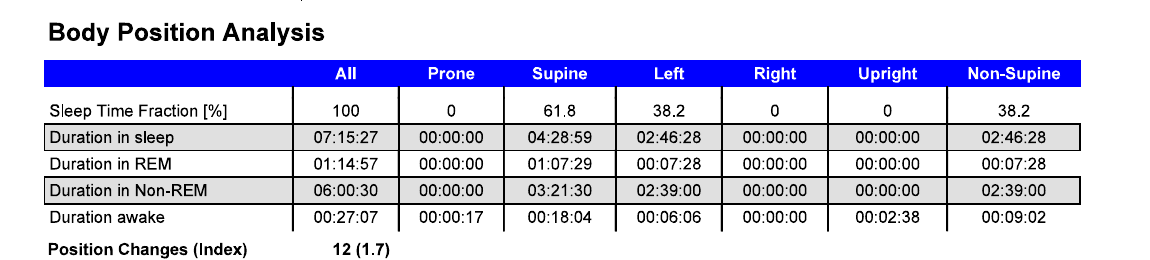
The position table recorded 61.8% of sleep time supine and 38.2% non-supine. All of that non-supine time was recorded on the left; the study recorded no right-side or prone sleep.
What this result does—and does not—say
This report documents one person on one night. It does not establish that the same position difference is typical, that left is better than right, or that a particular sleep position is appropriate for another person. Because no right-side sleep was recorded, this study cannot compare left with right.
Clinical guidance from the American Academy of Sleep Medicine recognizes that some people can have a lower AHI away from the back, while emphasizing that a positional response should be documented with sleep testing rather than assumed. A qualified clinician should interpret sleep-study results and recommend any treatment or position plan.
The question that became NightPosture
The clinical report could show body position during the study night. It could not answer what happened at home on later nights. That gap led to a narrower product idea: make the overnight position pattern easier to observe.
NightPosture records estimated Back, Left, and Right patterns from a chest-worn motion sensor. It shows a timeline, tracking coverage, turns, and longer-term position patterns. If enabled, it can provide a configurable nudge after Back remains confirmed.
NightPosture tracks
- Estimated Back, Left, and Right position
- Position timelines and tracking coverage
- Turns and optional nudge estimates
NightPosture does not track
- Breathing events or airflow
- Blood-oxygen saturation or sleep stages
- AHI or a sleep-apnea diagnosis
Position data can support observation and a conversation with a clinician. It cannot show whether breathing improved, prove that position caused an outcome, or replace a clinical sleep study.
Source and privacy notes
- The excerpts above come from a private clinical overnight sleep-study report and are published with permission.
- Patient identifiers, dates, clinic contact information, staff names, and institutional branding have been removed.
- The clinic that performed the study did not develop, validate, or endorse NightPosture.
- Clinical context: AASM Clinical Guideline for Adult Obstructive Sleep Apnea.